All posts by Tim Boester

Origin Stories: Greek Temple

The first Greek Temple puzzle coincided with the first time that I tried to align the content of my puzzle column to the content of the magazine. Prior to the fall of 2004, I basically just created whatever puzzles I wanted to. Starting with Issue 12 of Imagine, I began creating puzzles that matched the theme of each issue. With the first issue being Archaeology & Paleobiology, this provided an opportunity to publish a new type of puzzle I had been working on for a while.

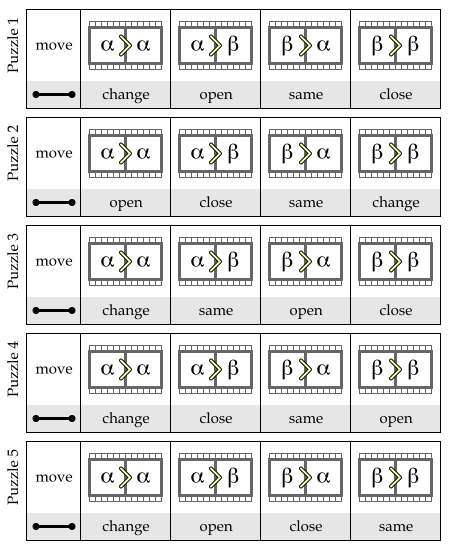
Unfortunately, back then I didn’t consistently keep very good notes about creating puzzles, so I don’t know exactly when I created the first Greek Temple puzzle. I do know that, prior to the fall of 2004, I had made an entire set of smaller Greek Temple puzzles based on the idea of linking the four possible state changes for the gateways (open, close, change, same) to the four possible options of moving between two tiles (alpha to alpha, alpha to beta, beta to alpha, beta to beta). While the graphical style of the puzzle has remained remarkably consistent over the years, I don’t remember how I came up with that original idea. The set of smaller puzzles has never been published, as they really belong together as a complete set; instead, each time a history or archeology issue comes around, I’ve chosen to create a new Greek Temple puzzle.

I did create a backstory for the puzzles to help me with some of the design details: A couple of archeologists have recently unearthed these ancient yet pristinely preserved structures. They accidentally realize that, with the introduction of a source of water, stepping on certain tiles at the entryway opens each temple’s doors via some sort of hydraulic mechanism. Yet they do not know why these structures are here, what they are for, or why they are the first to discover them in regions that have been thoroughly explored before.

GT Published Keys

Finally, each puzzle thus far has used a different pairing of gateway state changes and tile jumping options (see above). There are only a finite number of these, so I’ll necessarily need to start repeating, but some of the possible combinations keep the gateways open more often and some keep them closed more often. I’ve tried to stick to combinations that strike a balance. Regardless, it has been an interesting aspect of the design challenge to see how these combinations affect movement within the puzzle space.

Update: Greek Temple

Note: this blog entry shows some parts of Greek Temple puzzle solutions. Go back and solve the puzzles first!

Before this update, I had only ever posted to the website the first two Greek Temple puzzles (12.1 from 2004 and 13.2 from 2005). Subsequent Greek Temple puzzles (18.2 from 2010 and 19.2 from 2011) published in the magazine fell at a time when website updates were sporadic at best. With the most recent puzzle, it was time for a major update.

Most of the graphics have remained the same since my initial conception of the Greek Temple puzzles. For this update, I did, however, adjust the positioning of the alpha and beta labels on each tile.

alpha
Old (red, top) vs. new (blue, bottom), magnified 8x

This realignment was necessary to accommodate the biggest part of the current update: new, detailed diagrams that indicate solution steps though open and filled circles on each tile. Solutions were originally posted (and will continue to be posted in the magazine for compactness) as text through cardinal  directions (N, S, E, W). This solution representation isn’t optimal, since it requires the reader to move through the solution one step at a time, going back and forth between the text of the solution and the puzzle diagram.

Thus, I’ve created these solution diagrams that show the path of the solution on the puzzle diagram itself, grouping several steps together at a time (using the same slideshow technique used with the Space Pod puzzles). It isn’t typically possible to show the entire solution at once, since this type of puzzle often relies on moving back and forth between tiles in order to change the state of the gateways.

gt.Solution01INa3
Greek Temple puzzle 1, solution step 3: you have to take a step backwards first in order to open the gateway and move to the altar

Working out how to represent the overlapping parts of the solution path was one of the hardest aspects of designing clear, useful solution diagrams. Another challenge was that the solution path needed to represent two simultaneous pieces of information: your physical position in the puzzle, as well as the orientation of the gateways. This was resolved with using the open and filled circles.

One benefit of these new diagrams is that it also allows me to point out important parts of the puzzle space, so that I can describe why the solution must go the way that it does. While it is possible to represent the problem space of each puzzle as a tree diagram, I think it is more useful (for similar reasons described above) to show the loops, dead ends, and traps in the actual puzzle space.

gt.Solution05OUTb
Greek Temple puzzle 5, traps and dead ends

One final conundrum involved describing these pathways through words as your orientation to the puzzle space changes as you move through it. I decided to give directions for turns (left and right) based on your current position, but to describe parts of the temple (front and back) with respect to facing the entrance. This seemed to be the least confusing out of many bad options.

Crossword Plagiarism

I’m terrible at word puzzles, so I don’t spend much time with them: solving, creating, or following. But crossword puzzles are so ubiquitous that I can’t help being interested (Wordplay was a fascinating documentary). In characteristic fashion, FiveThirtyEight adeptly reports an emerging plagiarism scandal in the crossword puzzle community. Traditional puzzle “news” is rare, so this is big.


Update: Timothy Parker, the crossword puzzles editor, has stepped aside while USA Today and Universal Uclick investigate the claims detailed by FiveThirtyEight.

Numbrix

I recently went through a pile of newspapers that had accumulated over the past few months, only to discover this:

Numbrix
Compare the given numbers around the edges…

Huh.

Generate puzzle, publish, then rotate 90° and reprint a few weeks later. I never would have thought of that! It’s a real time saver. I guess I’ve been doing this whole puzzlemaking thing wrong all these years.


I haven’t been able to find any indication of how popular Numbrix puzzles have been since their 2008 debut, but seeing as they have stuck around in vos Savant’s “Ask Marilyn” column and are now available as a daily online version, they must attract at least some measurable level of reader, uh, solvership.1

Numbrix puzzles are an easier variant of Hidato, which allow diagonal connections and do not restrict the grid boundary and number chain length to be, well, anything in particular. Like Sudoku and many other types of number-based puzzles, Numbrix can be generated and solved via computer algorithm, although vos Savant claims she generates every puzzle by hand:

According to vos Savant, she created Numbrix partly for her readers and partly for herself. “I developed the puzzle to offer readers an enjoyable diversion that would exercise their fluid intelligence (meaning: logic plus memory) at the same time,” she says. “But the real fun for me was constructing every puzzle by hand — no real Numbrix puzzles are generated by a computer — and proofing it the same way to create puzzles that had unique solutions.”

– Chris Warren “How to Play Numbrix” 21 July 2011.
HowStuffWorks.com

That only makes the above revelation all the more conspicuous. But the blame may not rest solely on vos Savant, since Parade now lists Jeff Marchant as a contributor of Jadium puzzles, which claim to be harder than the similar Numbrix because they contain fewer givens. However, after researching all of these different types of number chain puzzles, it is still unclear to me what exactly the difference is between Numbrix and Jadium puzzles (both can contain 16 givens), what the division of authorship is between vos Savant and Marchant, or if the puzzles are still being generated by hand.

I’m not trying to disparage comptuer-generated puzzles in general, or vos Savant’s Numbrix in particular, since I use a lot of computerized tools while creating my own puzzles, although much of the heavy lifting in creating Knossos Games is still done on paper. Why should a computer have all the fun? Because of their hand-crafted nature, I don’t publish puzzles with great frequency. But that also means the expectations I have on my own puzzles are very high. While those aren’t always met, I’d be absolutely mortified by the above mistake.

Site Updates: November 2015

An ongoing catalogue of Knossos Games website issues and minor updates.


Just before an election where gerrymandering was on the ballot in Ohio, updated versions of the gerrymandering puzzles were posted.

Logic puzzle 18 was posted.

An updated version of the instructions page for the Greek Temple puzzles was posted. This is a sneak preview of an upcoming major update to the entire set of Greek Temple puzzles.

The spacing of the homepage, in particular along the lefthand sidebar, was adjusted to better match that of the rest of the site.

Origin Stories: Gerrymandering

The idea of using gerrymandering as the basis for a puzzle was not originally mine. The credit goes to my Imagine editor at the time, Carol Blackburn, who suggested it while discussing over e-mail the topics for the twelfth volume of the magazine (2004-2005). As soon as I read her idea, it immediately struck me as a great idea for a puzzle, so much so that I checked around first to see if anyone else had made a puzzle based on gerrymandering. To my surprise, no one had1.

This is a good opportunity to discuss puzzle suggestions and what I look for in a new puzzle concept. Carol’s idea for a gerrymandering puzzle was actually the first useful suggestion I’d ever received to make a new kind of puzzle. Over the years, I’ve received some feedback and a few fan letters from Knossos Games puzzle solvers. Suggestions for puzzles tend to go along the lines of, “Hey, you should do a puzzle about dinosaurs!” While I genuinely appreciate the feedback people give me, recommendations like these aren’t very helpful, since it’s not usually obvious to me what about (in this case) dinosaurs would make for a good puzzle. My response to these suggestions is always: “No, you should create a puzzle about dinosaurs, since you clearly have an idea of what a good puzzle about dinosaurs would look like.”

So what was different about Carol’s suggestion? To answer this question, I need to explain what I am looking for in a new puzzle concept. Puzzles are always based on rules.  The rules could be simple or complicated, few or many, obvious or obscure. Sometimes the stated rules for the puzzle conceal an entirely different set of rules that you can only discover by wading into the puzzle itself. Some of the hardest puzzles are those where solving the puzzle requires discerning the unstated rules by which the puzzle operates. Regardless, puzzles need rules, and coming up with new puzzles means coming up with new sets of rules. So I’m constantly on the lookout for real-world situations that contain some inherent rules or structure that I could build upon or transform into a puzzle.

This is what struck me about Carol’s suggestion of gerrymandering. All I knew about redistricting at the time was that it had to do with the process of forming political districts, and that it could be used nefariously2. But I immediately recognized that gerrymandering must have some underlying mathematical principles that could be utilized to make a puzzle. (In fact, actual gerrymandering could be considered a legitimate puzzle in and of itself. How no one else has thought to make a puzzle out of this is beyond me.)

The first step in exploring if my instinct was correct, that this would make for a good puzzle, was to learn more about gerrymandering. I found a lot of information concerning the history of gerrymandering, less on the mathematics of how it can be achieved. I’ve lost the reference where I first learned of the techniques of packing and diluting, perhaps it was this portion of the wikipedia entry. These mathematical techniques form the basis of how political redistricting can be used to affect election results, and as such they would need to form the basis of the puzzle.

The details surrounding the actual puzzles, like using square precincts (at first called “sub-districts”) in a square territory, and having yes and no votes (rather than democrat and republican, for example), were chosen to keep the rules simple, emphasize the mathematics of redistricting over the politics of it, and focus the difficulty of the puzzles on forming the districts themselves. I also recognized early on that the instructions would need to guide puzzle-solvers through the two main techniques they would be using to influence the vote, and thus example puzzles demonstrating those techniques would be necessary.

The final secret to these puzzles is that, once the gerrymandering cover story is wiped away, all that is left are pentomino tilling problems. The 5×5 grids can be divided up in many ways, and the precinct vote totals are what influences how one decides between multiple possibilities. So while I want solvers to learn about gerrymandering, on another level, there is something to be learned about tiling problems here as well.

Imagine has run two election issues, one in 2004 and another in 2008. When I made the first gerrymandering puzzle, I actually made several of them. Coming up with a cogent set of rules for myself as to how to design this type of gerrymandering puzzle, in which there is only a single solution, was very difficult. So in most cases, when I succeed in forming a new type of puzzle like this, I make more than one puzzle. I had hoped that Imagine would run another election issue in 2012 (and I’m lobbying for one in 2016), because I have several of these to share, in both the 5×5 size and a harder 7×7 size (where districts are septominos, containing seven precincts).
Update: Gerrymandering

Spoiler alert: a solution to one of the gerrymandering puzzles is shown at the end of this blog post. Go back to the puzzles if you haven’t finished solving them!

Even though a new gerrymandering puzzle hasn’t been published in the magazine since 2008 (that was the last time an issue was politically themed), that was right around the time the website had its last major update. Thus, there wasn’t a lot of work involved in updating the gerrymandering puzzles to the latest version of the website.

One choice that may disappoint puzzle solvers out there: I took down a few gerrymandering puzzles that I had posted to the website that were never published in the magazine. I’m trying to reorganize the puzzles I have (not just the gerrymandering puzzles) in order to plan for the future of Knossos Games, and in this case that meant removing a few puzzles. I’m lobbying for a politically-themed issue of Imagine to appear soon, so that the magazine can publish another gerrymandering puzzle (or two).

As for specific changes to the puzzles and instructions in this update, there were only two major ones. First, a colleague of mine suggested that I replace “sub-district” with “precinct”, since that’s what we (in the United States) call the territories that collectively make up political districts. As soon as he suggested it, it seemed so incredibly obvious. This rewording appears in the main instructions page (and corresponding PDF for printed instructions), instruction reminders for each puzzle, and the detailed solutions.

Second, I also updated how the solution is shown. The solution to each of these puzzles needs to communicate two pieces of information: how the grid of precincts is physically divided into districts, and how this dividing up of the vote count results in more no voting districts than yes voting districts. Before, I showed these two pieces of information separately by displaying a full sized grid with the districts outlined and, off to the side, a separate list of the no and yes voting districts. I always thought this was a little clumsy, since you need to scan back and forth between these two pieces of information to make sense of the solution. I can’t believe I hadn’t thought of this before, but coloring the districts and linking their (also colored) vote totals brings these two pieces of information into one graphic. I think it’s much more clear now, even before getting to the detailed solution, how each solution works.

gm.Solution05OLD
original solution graphic
gm.Solution05NEW
new solution graphic